15 MILES ON THE ERIE CANAL
For the second quarter of the 19th century, American turned left at Troy and floated west toward Buffalo,Cleveland, and the frontier beyond. As the Erie Canal lowered the price of freight from $100 to $10 per ton, manufacturing towns grew up along the canal, and prospered even as the railroad lines that paralleled the canal drained away its business.

The easternmost stretch of the canal strung together industrial towns, each of which evolved into a national center for producing a particular product. In their time, these towns sported all the trappings of success, from mansions to "opera houses" to neat blocks of two flat houses with wide porches to "scientific" red brick mills that were shown on postcards.

But in time, the industrial revolution which made these towns humbled them. Far from developing markets and losing competitive advantage as cheaply-transmitted electricity replaced water power, these towns began to fade as early as the 1920s, took a body blow from the depression, and absorbed 50 years' pummeling in the post-World War II decline of the rust belt.

What's left of all the grandeur today? Actually a great deal, beneath the tarnish. But you may have to look fast...

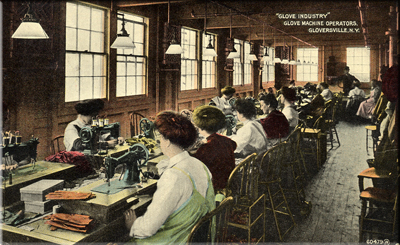
Gloversville, NY abuts the canal town of Amsterdam. Close to the deerskin and tamarack bark harvest of the Adirondacks, Gloversville was for many years the national center of the industry which from which it took its name. When young Sam Goldwyn was rising from cutter to the greatest glove drummer in the history of the town, Gloversville was prosperous enough to support a network of trolley car amusement parks and an opera house fittingly called "The Glove". But the domestic "skin" industries never recovered from the removal of tariffs on foreign competitors in the late 1920s.

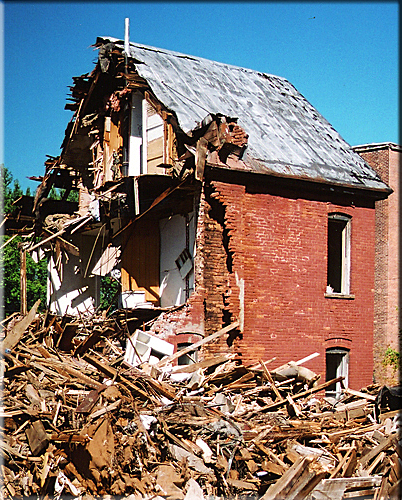
Recently a state grant paid for a first class restoration of The Glove as a live theatre. But the more common fate is that of the plain but substantial circa 1900 workingman's house above. In August, 2002, it was one of four downtown houses demolished for (of course) a parking lot. Before that, I think it had stored used appliances.

RIGHT: Gloversville works, circa 1910.

Although it was the world's leading manufactory for straw brooms for decades, Amsterdam, NY was "the carpet city" in its heyday. Just after the turn of the 19th century, this town of 20,000 ranked between New York and Philadelphia in the nation's top carpet manufacturing centers. The owner of the largest mill bred the 1914 Kentucky Derby winner on an estate at the city's edge. But by the 1950's, the carpet industry had largely fled to the low wage south, and the mansions were crumbling. Even the city's NY Yankee farm team, the Amsterdam Rugmakers folded, and a wide swath of the Victorian downtown was demolished for an urban renewal and highway by-pass project. Eventually the magnificent stone pillars that marked the graves of the mill owner's champion stakes horses vanished as a shopping center devoured his estate.

This East Main Street mansion presented the face of a staid patrician townhouse to the world for years. But the demolition of its neighbor has revealed a more fanciful side of its personality, not to mention that spectacular polychrome roof. The tower must have a spectacular view of the Canal and Mohawk River.

:

The nine miles from Schenectady to Amsterdam was most of an afternoon's journey on the Canal. But by the 1920s, it took just 25 minutes to commute from the Carpet City to the Electric City. In the 1920's Schenectady was a true city of 90,000, with a diversified industrial base beyond the General Electric Works that employed 20,000 workers or the ALCO plant that built over 30,000 locamotives. The city was a research center, in 1928 the site of the first television broadcast to combine picture and sound. State Street was a boulevard of department stores and theatres that drew crowds of customers from across the Capital District. But in time much of the industry left town. By 2000, the State Street business district was named one of the most imperiled historic neighborhoods in New York State.

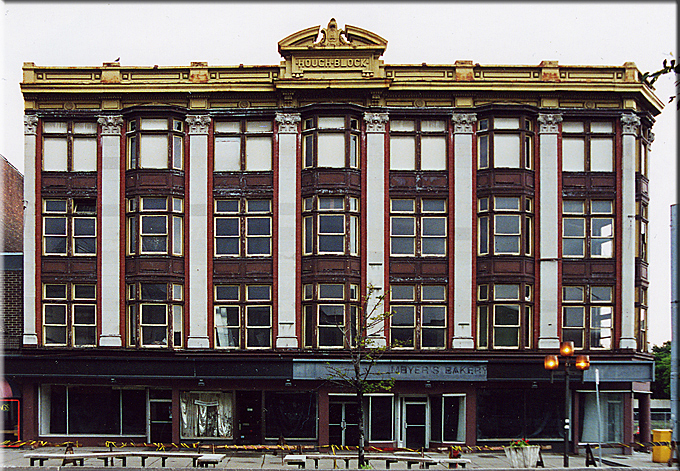
I'm told the Hough Block started life as a fashionable hotel with fancy shops at street level. One hundred years later, the glamor was gone, butthe building was being used as office space until shortly before this picture was taken in July, 2001. Today, however, the corner of State and Erie is a deep hole from which a state office building will rise. R.I.P.

Perhaps Troy's most enduring claim to fame is that it was at the true start of the Erie Canal. But the nickname immortalized in the name of a Hudson River bridge is "the Collar City". Those one time fashion staples of the day when a shirt couldn't be washed after each wearing, the detachable collar and cuff, were invented here. And making them was big business. In the 1890s almost 15,000 workers were turning them out, and the city dominated the world market.

Actually made much more than collars, including paper boats, pre-fabricated cast-iron building facades, and the first Bessemer furnace steel in the United States. But it was the old story. Eventually industry moved on, and detachable collars went the way of deerskin dress gloves. Today, the industry that gave Troy its nicknmae is extinct in the city.

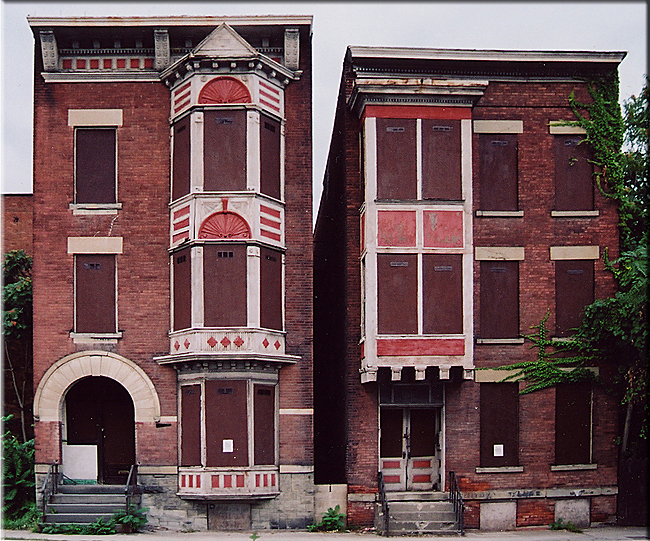
These handsome townhouses stand in an area with many vacant storefronts and seemingly abandoned rowhouses just north of the Collar City Bridge. The white square on the boarded windows is a placard reading "All buildings are created equal". It's great that they've picked up a guardian angel.

GOT A DISTRESSED MOHAWK VALLEY/TRI-CITIES BUILDING TO SHARE ?

I invite anyone with a Mohawk Valley/Tri-cities area building photo to send me a scan and the story behind the picture. I know that these towns have a less delapidated side, but I prefer the demolished, vacant, abandoned, distressed, imperilled. or just badly in need of a guardian angel. My e-mail address is psefton@crosslink.net